How to Reduce Resource Coordinator Workload and Keep Visibility

Resource coordination rarely collapses in a dramatic moment. It slows down. A request arrives by email, then a chat message, then a question at the desk, and the person holding the availability picture becomes the queue for all of it. Reducing the resource coordinator workload is less about finding one large fix and more about removing the repeated small tasks that fill the day.
The research behind this article is thin. Most of what was available consists of short search summaries rather than full studies, and the underlying publishers were not visible in the source material. Treat the strategies below as practical prompts, not proven formulas. Where a point comes from a specific snippet, it is labelled as such, and anything about your own team needs your own measurement before you act on it.
Why coordination work grows faster than the team does
Every new project adds a set of questions: who is free, who has the right skills, who is already overallocated, and what happens if someone moves. Each question is small. Together they create a continuous stream of lookups that only one or two people can answer, because only they can see the whole picture.
That is the structural problem. The coordinator becomes a human interface between people who need information and systems that hold it in fragments. If the answers live in a spreadsheet, a project tool, a finance file and someone's memory, every request costs a rebuild of context. The workload grows with the number of projects, not with the number of coordinators.
Audit the requests before you change anything
Start by recording what actually arrives. For one or two weeks, log each request with a short description, who asked, how long it took to answer, and whether the answer already existed somewhere. Do not try to fix anything during this period. The point is evidence.
At the end, group the entries. Most teams find a handful of repeated request types that account for a large share of the interruptions, and several one-off items that feel urgent but are not. This log also gives you something to compare against later, which matters because no source in the available research shows a measured reduction in coordinator workload from any particular tactic. Your own before and after record is the only reliable proof you will have.
What the workload advice actually suggests
The snippets available fall into a few themes. They are worth comparing because they address different parts of the problem, and none of them claims to be a complete answer.
| Advice theme | What the snippet suggests | Where it fits |
|---|---|---|
| General workload management | Set realistic goals, break larger tasks into smaller manageable components, and rebalance workloads so no one carries an unfair share | Restructuring the recurring coordination tasks themselves |
| Coordinator-focused advice | Set realistic goals, delegate and collaborate | Spreading the load beyond a single person |
| Leadership triage | Involve the team in deciding what can be paused, scaled back or cut, and advocate upward for more resources or more time | Deciding what stops rather than how to do it faster |
| HR view on urgency culture | Run a temperature check with teams, find out where urgency is coming from, and clarify roles | Reducing false urgency in the request queue |
Read together, these themes point in one direction. The workload is partly a volume problem and partly a design problem. Adding effort to a badly designed process mostly produces a tired coordinator.

Set realistic goals and break the work into smaller pieces
A workload management snippet summarised in search results recommends setting realistic goals and breaking larger tasks into smaller, manageable components. Applied to coordination, that means turning vague duties into defined, repeatable tasks with a clear owner and a clear finish line.
Instead of "maintain the resource plan", the work becomes a weekly availability refresh, a fortnightly overallocation review, and a monthly skills update. Each has a defined output and a time budget. When a task overruns, you can see which one it was rather than blaming the role in general. Breaking the work down also makes it possible to hand a piece to someone else without transferring the whole job.
Rebalance and delegate while keeping one view
A workplace stress article summarised in search results recommends rebalancing workloads when people are overloaded and regularly reviewing task distribution so no one is unfairly burdened. Coordinator-specific advice adds delegation and collaboration to the same principle of realistic goals.
Delegation has a catch. If three people each maintain their own version of availability, you have created three sources of truth and a new reconciliation job. Delegation works when the shared view stays shared and the delegated tasks are specific. Someone owns the skills data update. Someone else owns the weekly exception list. The coordinator keeps the overview rather than every keystroke.
Cut false urgency out of the request queue
An HR-focused snippet lists three useful moves: conduct a temperature check with teams, find out where urgency is coming from, and understand role clarity. In practice, that means asking why a request is marked urgent and discovering that many are urgent only because nobody planned earlier.
Try a simple test. Ask requesters to state the project, the decision the answer supports, and the date it is needed by. Requests without those three details wait. This is not about being unhelpful. It separates genuine scheduling conflicts from impatience, and it gives you data on which projects consistently create last-minute demand.

Let project managers answer their own routine questions
The largest category in most request logs is lookup: who is available, who has a particular skill, who is already committed next month. These are answerable directly if the data is current and the query does not require rebuilding a report.
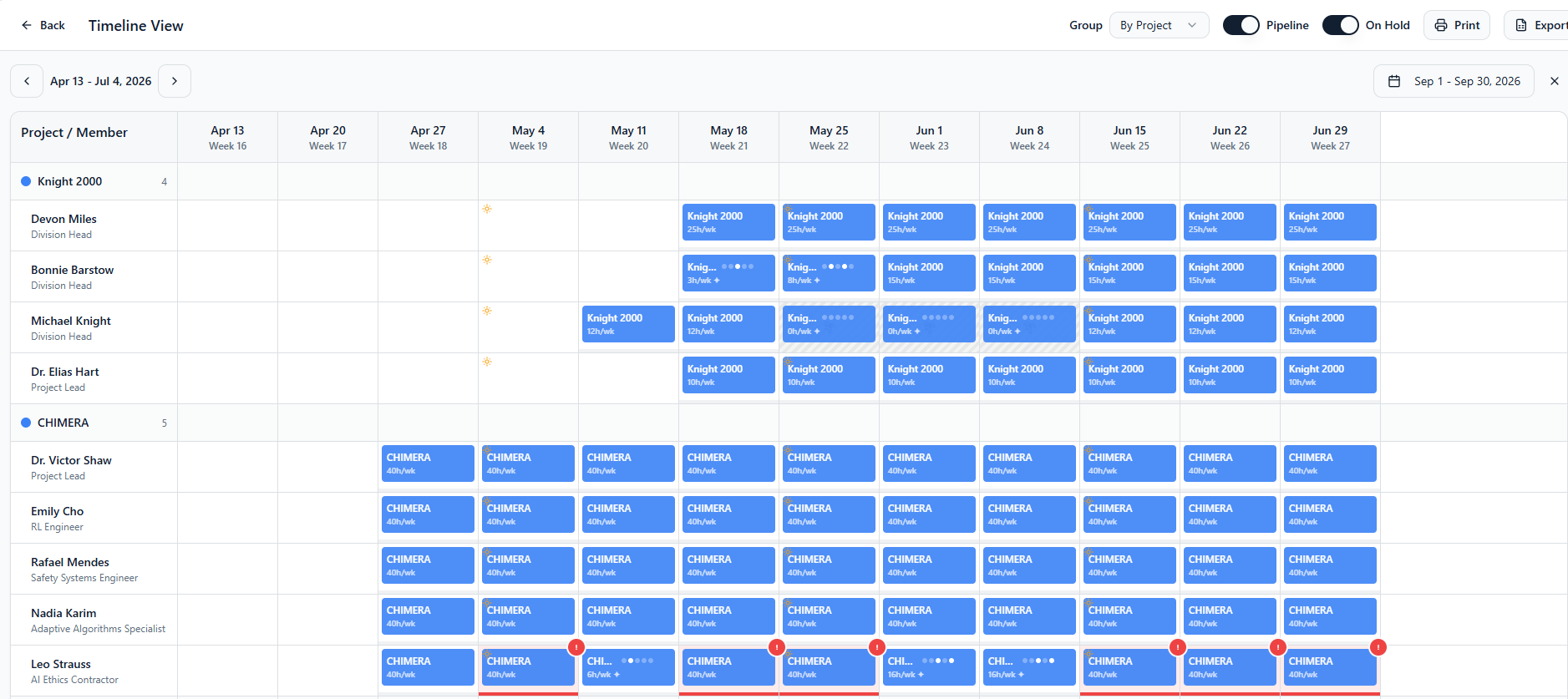
Avai-lability is built around exactly this pattern. It tracks availability and skills across shared resource pools, and its AI Resource Assistant lets project managers ask questions in natural language instead of waiting on a coordinator or a spreadsheet. Role-based access, with Owner, Admin, Manager, Member and Viewer levels, means people can see what they need without seeing everything. The point is not to remove the coordinator from the process. It is to stop routine lookups from consuming the hours that judgement work needs.
Decide what the coordinator should still own
A leaner process still needs a human in the middle of the difficult calls. Exceptions, negotiations between project managers with competing deadlines, escalations, and anything involving a conflict between delivery and commercial priorities belong with someone who can weigh the trade-offs.
Write that list down. Once the routine work is shared or self-served, the role becomes clearer and easier to defend when someone tries to add unrelated admin to it. Role clarity was one of the points raised in the HR snippet on urgency culture, and it applies just as well to defining what coordination is not.
What automation can and cannot do
Software can consolidate availability data, answer repeated lookups, filter by skill, flag overallocation and keep a single version of the plan. It cannot decide which project matters more, absorb the difficult conversation with a delivery lead, or take responsibility for a judgement call.
It also does not remove the need to maintain data quality. If allocations are not recorded, the answers will be wrong, and people will go back to asking a person they trust. Any tool decision should include a clear rule about who updates what and when, otherwise the manual work simply moves.

A practical 30-day starting plan
- Log every coordination request for two weeks, including source, time taken and whether the answer already existed.
- Group the log into the top five request types and estimate the share of total time each one represents.
- Choose one type to remove first, usually availability lookups, because they are the most repetitive.
- Agree with the team what will be paused, scaled back or stopped to make room for the change, using the leadership triage approach of involving the team in that decision.
- Define the request standard: project, decision supported, date needed. Publish it and apply it consistently.
- Re-run the log in week four and compare. Keep what worked, drop what did not.
Cost context before you commit
A salary snippet in the search results lists an average of $70,000 per year for a Resource Coordinator in Australia. That figure comes from a snippet only, with no award rate, employer benchmark or methodology visible, so verify it against current market data before using it in a business case.
For comparison, Avai-lability's published pricing is $4.89 per resource per month on the Standard plan and $7.50 per resource per month on Pro, with Enterprise quoted on request. Whether that represents value depends entirely on how much manual lookup time your team removes, which is why the request log matters more than any vendor claim.
Frequently Asked Questions
How long does it take to reduce a resource coordinator's manual workload?
There is no standard timeline in the available research, and anyone who offers one is guessing. A realistic approach is to run a two-week request log, pick one high-volume request type, and test a change for a month. The first measurable difference usually appears in the request log itself rather than in a formal productivity measure.
Will better tools remove the resource coordinator role?
Nothing in the research supports that conclusion. Software can answer routine lookups and consolidate availability data, but judgement, negotiation and escalation still need a person. The more likely outcome is a shift in the mix of work, with less time spent rebuilding reports and more time spent resolving genuine conflicts between projects.
How do we stop people bypassing the new process?
Role clarity and consistency do most of the work. Publish a simple request standard, apply it every time, and make sure the self-service view is faster than sending a message. If the shared data is out of date, people will trust a person instead, so data maintenance has to be someone's named responsibility.
What is a resource coordinator paid in Australia?
One salary snippet in the search results lists an average of $70,000 per year for a Resource Coordinator in Australia. That is a single unverified summary with no visible methodology, award rate or date, so check current market data and any applicable industrial instrument before relying on it for budgeting or salary discussions.
What should we measure first?
Start with the request log: number of requests, source, time taken to answer, and whether the answer already existed somewhere. These are easy to collect and give you a baseline. Avoid starting with satisfaction surveys, because they rarely show whether the manual effort actually changed or simply moved to someone else.